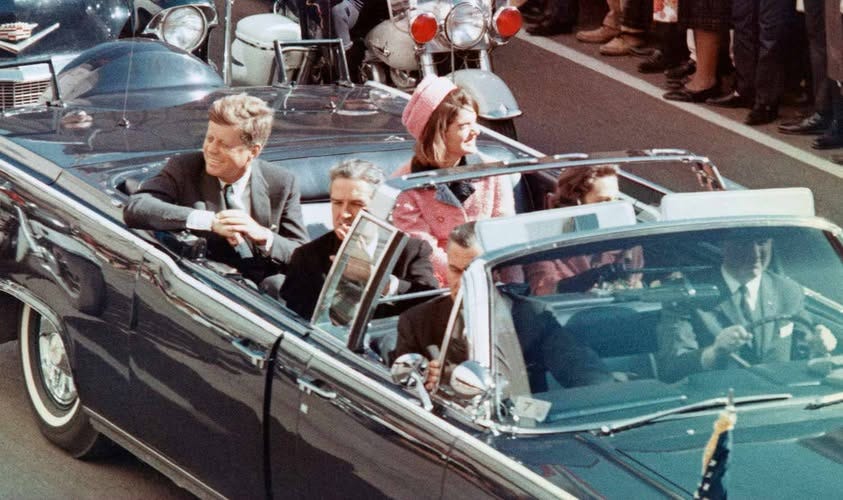
November 22, 1963
A First Grader's Impression of the Last Act of Camelot

In Mrs. Tucker’s first-grade classroom at DeQueen Elementary in Port Arthur, Texas, I sat gazing out the window, lost in thought—a habit that would earn me more than a few reprimands over the next twelve years.
The November sun lit up the courtyard, where Mr. Harvey, our custodian, was shoving trash into the big incinerator. Smoke puffed out the tall smokestack in steady bursts, the kind that made you think of autumn bonfires and the way fallen leaves would crackle and pop as they burned.
Secretly I wished I were out there helping him. At home, I was already Dad’s helper when we burned leaves, standing at his side as he carefully raked them into neat piles. I knew I’d be just as good at this monotonous chore. Anything was better than sitting indoors on such a pretty day.
On my desk sat the turkey project we’d just completed. Mine wasn’t the fanciest—it didn’t have the glitter some of the girls had added—but I was proud of it. I took one last sniff of the sweet Elmer’s white paste before screwing the lid on and tucking it into the storage space under my seat alongside my paper and scissors.
Mrs. Tucker was making her rounds, admiring everyone’s work, her warm smile lighting up the room.
The smell of lunch drifted into the classroom from down the hallway, and my stomach growled. It was almost time to eat, and the aroma of the DeQueen school cafeteria—yeast rolls and Friday’s fish—wafted down the hallway, I’d brought my lunch that day, though. Dad had packed it since Mama was away, helping my oldest sister Sandra with her new baby. The thought of being an uncle at six years old brought a grin to my face. I imagined holding the tiny baby, hearing the grown-ups call me “Uncle George,” and feeling just a little taller because of it.
But my daydreaming was interrupted when I noticed something unusual: Mrs. Tucker wasn’t making her usual rounds.
She was at the door, talking to another teacher, who was whispering urgently, her hand cupped over her mouth. I couldn’t hear the words, but I saw the shift in Mrs. Tucker’s face. Her ever-present smile faded, and tears welled in her eyes. The other teacher was crying too.
The room grew quiet as the children around me noticed. Out in the courtyard, Mr. Harvey kept feeding the incinerator, the rhythmic clang of the waste bins the only sound. Inside, our little group of first graders fell into a curious hush.
The buzz of crayons against paper and the gentle rustle of scissors cutting construction paper had stopped, all were silent.
Mrs. Tucker returned to her desk and sat heavily, reaching for her Kleenex box. She dabbed at her eyes and took a deep breath, but she didn’t speak.
Suddenly, above the chalkboard, the old speaker mounted high on the wall crackled. Then came the voice of Mr. Miller, our principal. But it wasn’t the strong, confident tone we knew from morning announcements. His voice trembled, and he cleared his throat twice before speaking.
“Boys and girls, we’re letting out early today,” he said, his words slow and measured. “Please pack your things. Your parents are being called to pick you up. There has been... an incident. President Kennedy has been hurt.”
Excited whispers broke out immediately. Our young, innocent minds jumped to the simplest explanation: maybe the President had fallen or scraped his knee on the playground. Maybe he was in our nurse’s office, just like we would be after a tumble. Mrs. Tucker didn’t shush us, though. She kept her gaze down, her face unreadable, her hands dabbing at her eyes.
Outside the window, I saw Mr. Duncan, the gym teacher, stride across the courtyard toward Mr. Harvey. He leaned in and said something, his voice too low for me to hear. Mr. Harvey dropped the trash bin he’d been holding, his shoulders slumped as he buried his face in his hands. Mr. Duncan put a hand on his shoulder, picked up the fallen bin, and secured the incinerator doors before leading Mr. Harvey back inside.
Mrs. Tucker finally stood and called for order. We packed our desks in silence, the chatter now replaced with a sense of unease we didn’t quite understand. We lined up and filed into the hallway like it was a fire drill. All around us from the other classrooms, children streamed toward the front doors, their faces quiet and puzzled.
Once outside, we were told to play on the playground until our parents arrived. The swings creaked and the merry-go-round spun lazily, but the usual energy of recess was missing. Sitting on a bench, I clutched my lunchbox and satchel and waited for my Aunt Olga, who had been called to pick me up since Dad was working the day shift at Texaco.
Climbing into her big yellow Plymouth I noticed it looked like she too had been crying. The ride to her house was quiet. Aunt Olga didn’t say much, she kept scanning the dashboard AM radio from station to station, there was no music playing anywhere, every frequency held the voices of somber men talking about Dallas. When we arrived, she let me eat my lunch and even gave me a bag of Fritos—my then favorite. “You can have anything you want,” she said, her voice soft and sad, as she turned on the big RCA black-and-white television in the living room.
Walter Cronkite’s voice filled the room before the picture tube warmed up enough to show his face. I had never seen anything like it before. The usual midday programs—soap operas, local commercials, even Dialing for Dollars—were gone. Walter spoke solemnly, explaining over and over what had happened in Dallas. President Kennedy had been shot and killed by something called a sniper.
Dad picked me up later, and at home, the television stayed on. Even after my bedtime, I could hear the steady hum of the news as Dad and my sister Marilyn sat glued to the screen. The world felt different somehow, heavier.
It was the last moment of the final act of Camelot.
The next morning, I woke early, as usual on Saturday to watch the cartoons. But Walter Cronkite was still there, his voice somber. He announced that the President’s assassin had been arrested. “Lee Harvey Oswald,” he said, repeating his full name so many times that it felt burned into my memory.
Saturday passed in the same surreal blur. I checked the TV occasionally, leaving my toys behind to see if Bugs Bunny, Mighty Mouse and the other cartoons had started up yet, but there was only more news. By Sunday morning, I was convinced the TV people realizing they’d missed showing the Saturday array of animated shorts would now make up for the missing cartoons.
Instead, I watched as they prepared to transfer Lee Harvey Oswald to another jail.
The screen showed Oswald being led out in handcuffs, a blur of men in suits and Texas Stetson hats surrounded him. Then, suddenly, a man in a Fedora stepped into the frame from the right. He raised a revolver and fired one shot, point-blank into Oswald’s guts, I remember Oswald’s scream and twisted face live on television.
The screen erupted into chaos. Reporters shouted. Stetson men tackled down the Fedora man. Even at six years old, I knew I was witnessing something extraordinary, something that would be talked about for years.
That weekend, I learned words like “assassination”, sniper and “motorcade.” I saw the faces of grown-ups I trusted—Mrs. Tucker, Mr. Miller, Aunt Olga, Dad—turn somber and uncertain. And though I didn’t fully understand the weight of what had happened, I knew the world had changed in a way that even a six-year-old could feel.
Life went on, NASA took us to the moon, there was Viet Nam, civil riots, and over the years more and more revelations about what all exactly happened in Dallas that sunny November afternoon. And I’m not six years old anymore on a sunny autumn day, and so some of those revelations rocked the foundation of my whole world and shaped much of how I view it today; the good guys aren’t always the ones in Stetsons, the bad guys aren’t always the ones in Fedoras.
Even still, on late autumn days when the sun is shining, and the wind is rustling the leaves on the ground, and I catch a whiff of someone lighting a pile of them it carries me back to first grade and Mrs. Tucker’s innocent room before it was shattered by a bullet.
And as the years roll by, and the world moves on, there are fewer of us who can say exactly where we were when Kennedy was shot.